Effective management relies on sustainability, ensuring the ecosystem stays healthy and continues to support both people and wildlife for the long term.

Drone Image over Flaxley Woods, towards the River Severn, Stroud and Bristol.
The wildlife
Wildlife is a high priority for us. With a broad range of well-established habitats already in existence on our estates, sustainability is key during and beyond the development of our vineyard, winery and restaurant.


Woodland
The composition of woodland and the way it is managed determines its value for wildlife. We appreciate the importance of tree species diversity, and the presence of very old trees and deadwood in our woodland. These features are historically not permitted in commercial management systems, despite the dependence of wildlife upon them. Striking a balance between making commercial woodlands productive and supporting the natural habitat is imperative. We have given careful consideration to gap size between trees, the amount of open space, and the amount of dead wood left in situ, all with the aim to maximise biodiversity.
The fuel for the biomass boiler at the Flaxley Estate will primarily be sourced from our own managed woodland (which has been neglected for 50-60 years, and so offers many dead and dying trees). As appropriate, wood will be removed for fuel and subsequently the woodland will be regenerated. When necessary, fuel will also be sourced from the Forest of Dean, which borders the estate. The aim of this system will be to minimise use of fossil fuels. Our Sustainable Woodland Creation Management Plan is being developed with ADAS (Environmental and Agricultural Consultancy) and with the co-operation of Forestry England.
Waterways
The stunning Westbury Brook runs through our Flaxley Estate. As well as offering beauty, this water course plays host to an array of wildlife, on it’s path to feed the River Severn. In partnership with the Environment Agency; Wildfowl and Wetlands Trust (WWT); Farming and Wildlife Advisory Group (FWAG); Forest Guardians; and the local Parish Council, we have undertaken extensive conservation work on the brook.
Most noticeably, we have fenced off an eight-metre easement along the length of the brook. This has prevented livestock entering the water, so preventing silt pollution, and promoting full ground cover with vegetation, included several wildflower species. The advantages of these measures to the natural habitat have been seen with then increase in wildlife and insects
The addition of twelve leaky dam structures along the course of the brook has seen new slow-moving pools, and a subsequent flourishing of aquatic life. These features carried out in conjunction with the Environment Agency also function as natural flood management
In consultation with Severn Trent, Kingsthorne has removed relic pipework which included asbestos, as well as plastic and metal. Water quality has improved as a result. In addition, a shallow pond has been introduced nearby, which offers land drainage to the surrounding valley, and hosts wetland flora and fauna. Redundant barbed wire and posts have been removed to reduce possible harm to the abundant wildlife using the area.
Westbury Brook is now part of a countywide project, offering training opportunities to citizen scientists. It is a flagship site, demonstrating what can be done by landowners for environmental betterment and natural flood management.
Meadowland
Under the guidance of local ecologist Liz Powell of Ecohab, Kingsthorne planted twenty-five acres of wildflower species in 2021. This planting followed a feasibility study into the viability of establishing wildflower meadows across the estate. Seed was gathered and prepared locally, so minimising transport and fossil fuel usage. Swards now include Yellow Rattle, Meadow Vetchling, Green-winged Orchid, Ox-Eye Daisy, Ragged Robin and Ladies’ Bedstraw.
Insect life
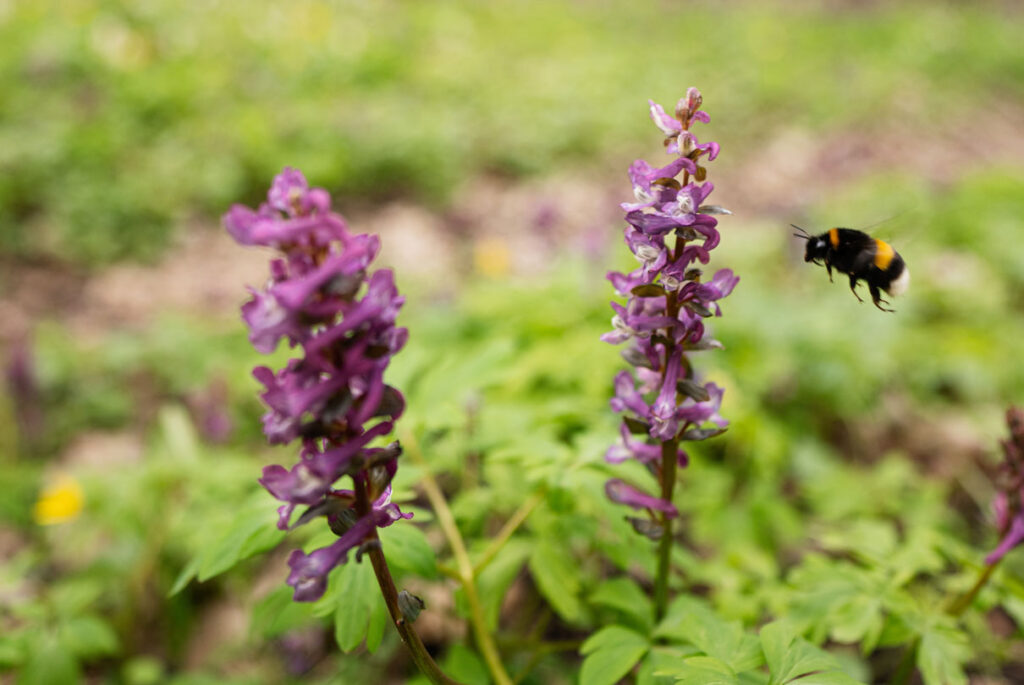
As mentioned above, the Kingsthorne estates play host to an expanding apiary. The bees aid pollination in our vineyards, orchards and wildflower meadows. Further introduction of wildflower corridors provides much needed networks for the pollinators that occupy our estate. The honey produced from our hives will be sold at the estate shop, and used to produce mead.
Our apiary was established with the guidance and advice of Christian Maass, a local beekeeper and specialist in non-medicated bees. We have now trained a member of the Kingsthorne team as an apiarist.
Our love for wildlife will extend to the addition of bug hotels across the estate, to provide plentiful space for nature to thrive and expand.
The Built Environment
Following various ecological surveys by Wildwood in 2022, 2023 and 2024, we have made extensive plans to provide for the wildlife occupying our currently derelict buildings. A large number of House Martins use our buildings for nesting. Care will be taken to carry out development works outside nesting season, and new buildings have been designed with eaves that make the building of nests even easier than in the current built environment.
Additional plans have been made for a bat hotel, bird boxes, and Kestrel home. The latter is at the request of the local church which has been hosting the local Kestrel population for some years.

Biodiversity Net Gain.
Wild Service Consultancy was commissioned in 2023 for a Preliminary Ecological Appraisal (PEA) and Biodiversity Net Gain (BNG) Assessment. Recommendations were made for the enhancement, creation and retainment of features within the estate’s grasslands, woodlands, hedgerows, and ‘in-tree’ field habitats. It was established that the predicted outcome of the recommendations would be a total net unit increase in biodiversity of 78.76% for all habitats, and 49.39% for hedgerows in particular. A positive outcome for the estate, and the government’s local strategy for biodiversity enhancement.